
WWII End Game: Chasing the Enemy Across Germany
The lawyer called to tell me, as executor to my Uncle Bob Daley’s estate I was entitled to his personal effects. I was sent a box containing his watches, his wife’s jewelry; things you would expect to find. But there was something else, a small package of photographs. My Uncle Bob was my mom’s brother. I knew him when, as a young boy, my mom would drive us to Kingston, NY where he lived quietly with his wife Louise. Bob and Louise spent their time playing golf and entertaining friends. He never once spoke his time in World War II and I was too young to ask questions.
Robert Henry Daley, my Uncle Bob, was born in Bridgeport, Connecticut on July
28, 1910. His parents. Arthur and Margaret Daley were immigrants from Ireland. He had nine brothers and sisters. He married Louise Niely in 1937 and worked as a Postal Clerk for the U.S Postal Service’s Railway Mail Service. He sorted, routed, and dispatched mail on railroad mail cars. At age 33, he enlisted in the Army on March 15,1943. He was one of those Americans who joined the Army, served during WWII, then returned to his life. He led a good, quiet life working as a postal inspector on trains the rest of his life.
Uncle Bob was trained as a Fire Direction Center Operator, MOS 645. That meant he prepared firing charts for vertical and horizontal control. He set up and operated such fire control instruments as the aiming circle and range finders. He served 14 months with the 754 Field Artillery in France, Holland, Belgium, and Germany. He served for the Rhineland and Central Europe battles and campaigns. He qualified as a Marksman Sharpshooter for pistol and Carbine. He was never wounded. Along the way he was given the Good Conduct Medal, The European African Middle Eastern Theater campaign Ribbon, The American Theater Campaign Ribbon, and the Victory Medal. He achieved the rank of staff sergeant. He was honorably discharged on November 8, 1945.
I knew nothing of my Uncle Bob’s involvement in WWII. I was left with his photos to piece his story together and with his band of brothers; a story which also needs to be told. As I looked as the pile of thirty photographs, hidden away in his personal effects, I realized he took photographs during WWII. Fortunately, he wrote on the back of some of them which allowed me to piece together where he went and what he was doing after D-Day in those fateful years of 1944 and 1945. I will never understand fully the impact WW II had on him or all the men and women of that generation that went to war. My Army service twenty years later was different.
It was the end game of WW2. The American and English armies pushed the German Army backwards. History has highlighted the magnificence of D-day invasion, the toughness of the Battle of the Bulge, and the glory of the Band of Brothers. Yet, there other stories, of other soldiers, not all on the firing lines. The “backwar” has a story also.
The following photographs were taken by Staff Sergeant Robert Daley as the 74 Field Artillery Battalion moved across Germany and Austria in the last six months of WW II. His notes on the back of the photos are in quotes.
Floverich, Germany supporting the crossing of the Roer River. Nov. 24,
1944
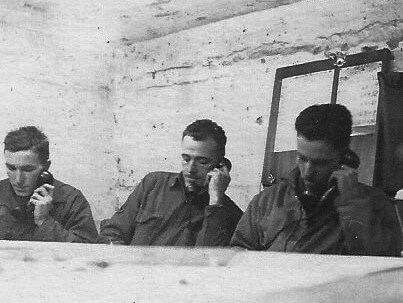
“This part of F.D.C. operation. Brache, me, Bayless, Dec. 1944. This was a backwar development”
Eden,Nov. 24, 1944
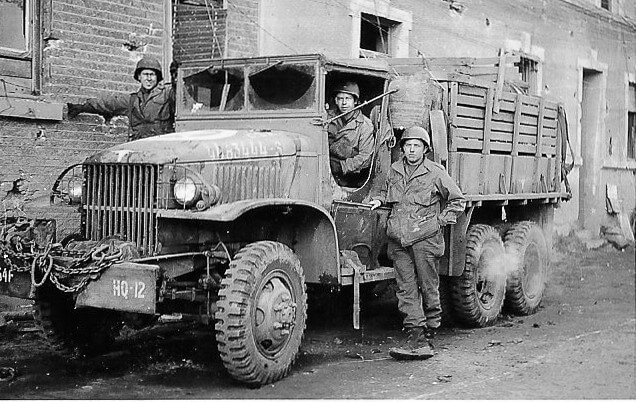
“Ederen: Hessen, Picace, Clappe”
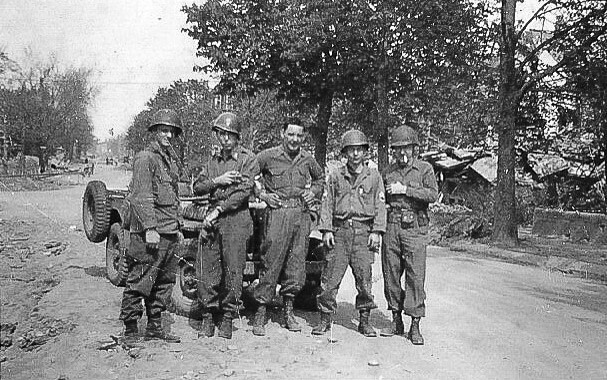
“Ederen: Van Kley, Lt. O’Loughlin, Tom Bond, Skeets McKinstry, D.l.Scheid” Feb. 2, 1945 Waldfeucht, Germany February 2, 1945
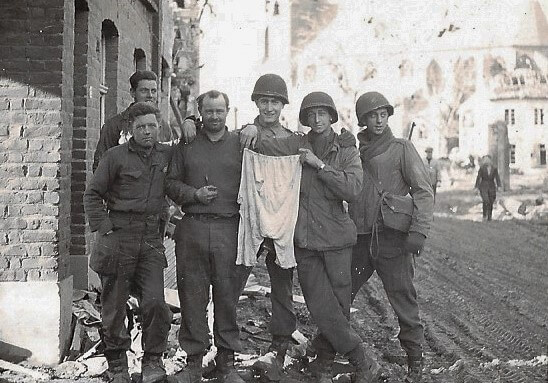
“Waldfeuch: Wilson, Schivey, Pop Parsons, Masinado, Kimmel, Sharpe”
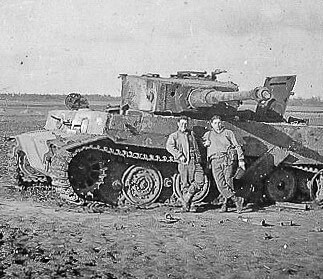
“John Clark and Pete Bunnelle and knocked out Tiger tank “
Dries, March 4, 1945.
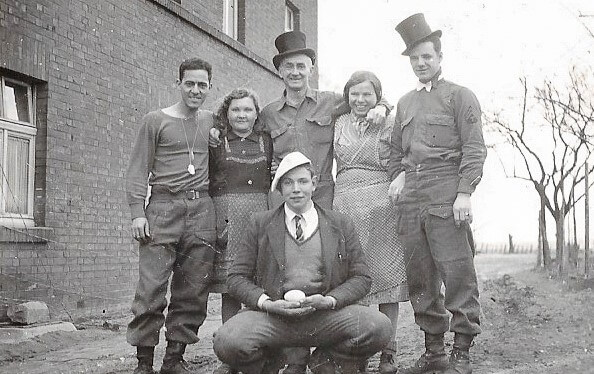
“This was taken outside the farmhouse we in Dries, Germany. This was our first firing position after crossing the Roar. “March 6, 1945”
“Hugo Braghe, Frederick the Great, Maria, Van Clef, Nadia, Valentine, Garfield”
Gladbeck, Germany March 30, 1945
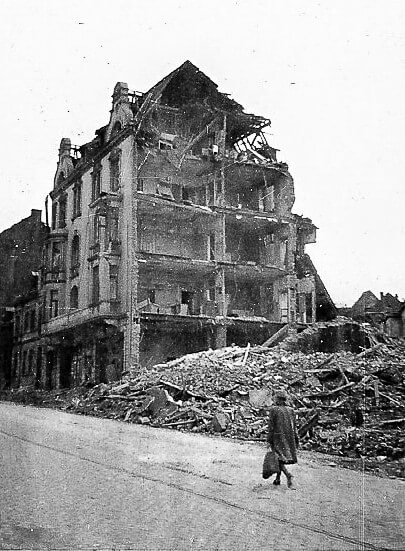
Beur, Germany, April 8, 1945
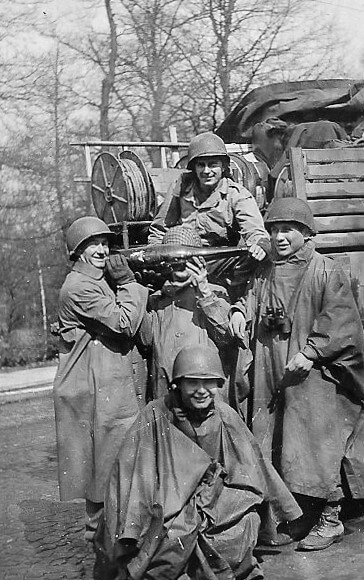
“Buer: Whitewolf, Tracy, Mathesen, Campbe
Essen, First contact with displaced persons, April 12, 1945
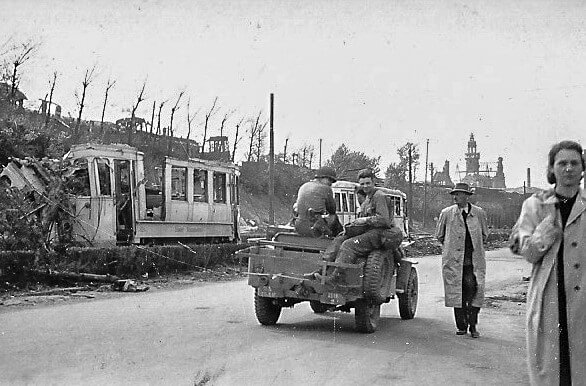
“Scene from Essen: Scheid and Van Kley”
Hoxter. Unit is now the military government there. April 18, 1945
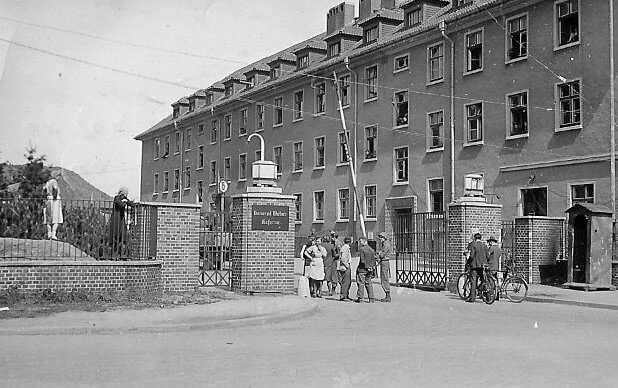
+East gate of General Weber Caseerne (Correct spelling: Kaserne, meaning barracks) where the Displaced Persons (Russians, Poles, Italians, etc.) were housed before shipment back towards their home country.
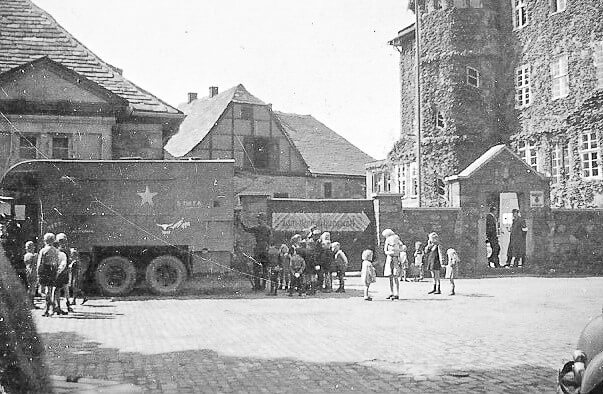
“The donut and coffee truck in front of the school at Hoxter. The building. in background is the courthouse.
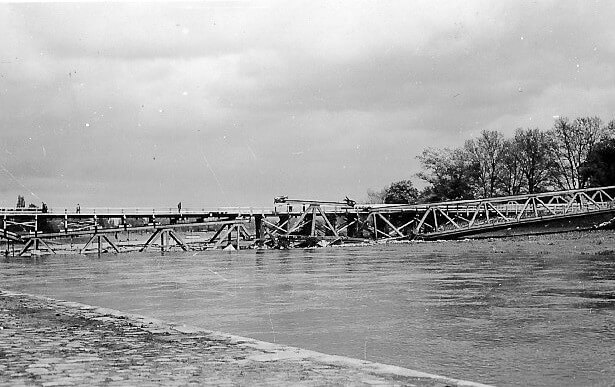
“Temporary bridge across the Waser at Hoxter. The original bridge was blown by the Krauts in their retreat east.
Atkinson, Sharpe, Van Kley, Through the windshield are McClure and Matheson
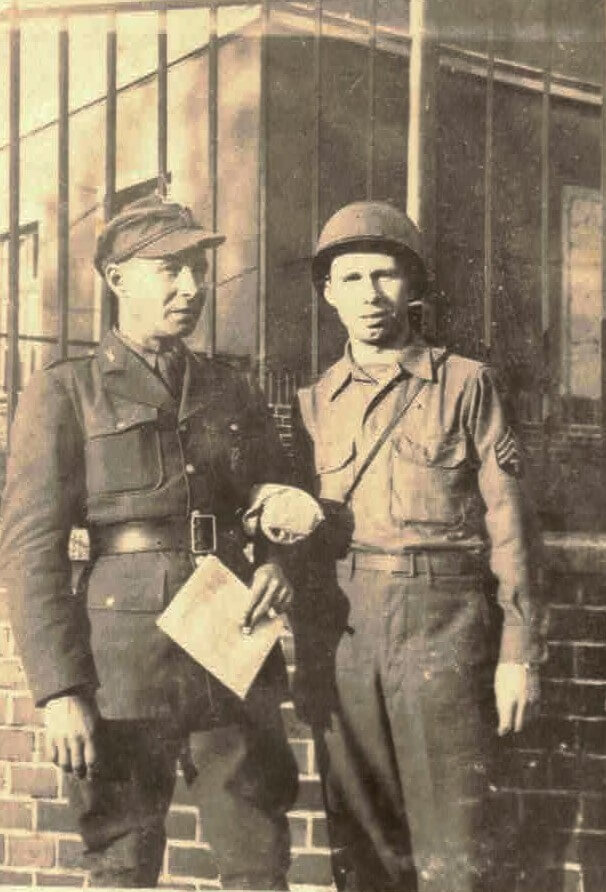 |
” Polish Lt.Zavatzesskinski and Sgt. Muealberger
Taken at Gen. Weber’s Caserne, Hoxter, Germany
May 7, 1945 Germany surrenders
June 4, 1945. Cross Danube to Munich
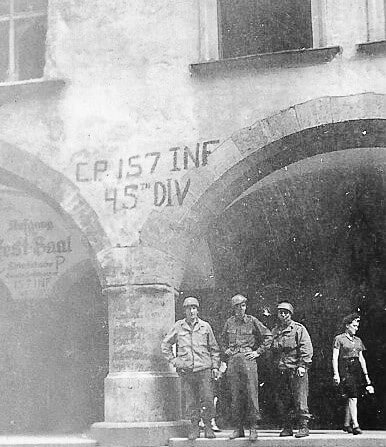
“Maj. Bever, Capt. Pike, Pvt. Guthmiller. Entrance to Hitler’s Bier Ball, Munich”
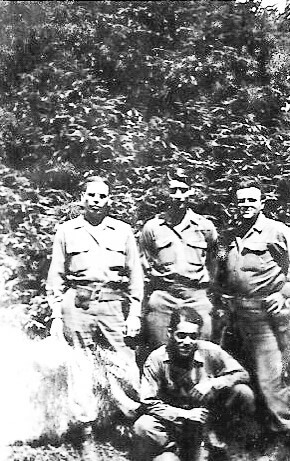 |
Bunnelle, Langhofer, Dryer, Brache, Andorf, July 9, 1945
Honorable discharge, Fort Devons, Mass. Nov. 8, 1945
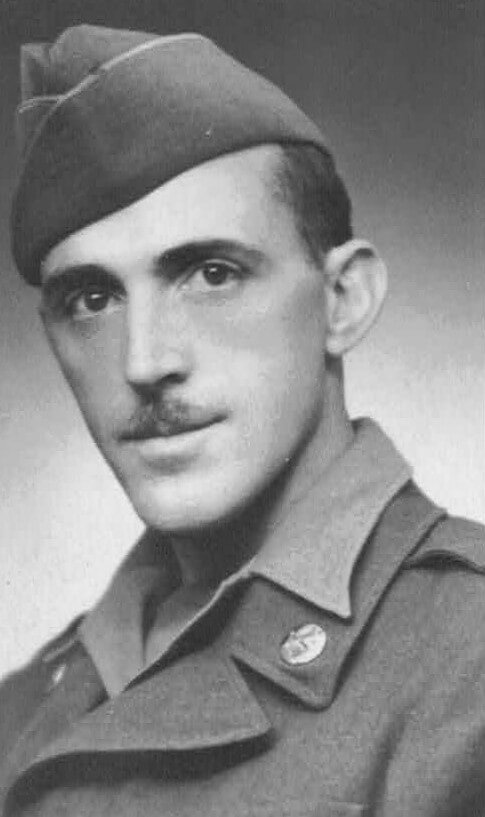
My uncle Bob, just another guy from Bridgeport, Connecticut, who served his country and returned to civilian life. As Bob Daley’s battalion fought and chased the German Army across the battle fields, he took the time to take a few pictures and record the names of the men and places they fought. He recorded his band of brothers. It is a history that few today know or understand. Lest we forget these other places and voices, some from an old box of photographs, the history of WWII will never be complete.
REFERENCES
The History of the 754th FA BN, WWII ETO
March 6th, 2013 by Ulmont E. Robinson and Charles Schmeling
The Roer River Battles by David R. Higgins, 2010
Robert Henry Daley’s “Honorable Discharge.” “Enlisted Record and Report of
Separation,” and “Separation Qualification Record,” Army of the United States, 1945.
APPENDIX I
Timeline for Staff Sargent Robert H. Daley
March 15,1943 Enlisted in U.S.Army, Hartford, Conn.
Boot Camp Trained as Fire Direction Center Operator, MOS 645 in, Day
Aug. 3, 1944. Waiting to probably Fort Bragg, N.C.
June 6, 1944, D- day go to ETO at Camp Shanks, Orangetown, N.Y,
Aug. 9-11, 1944 Aboard the Edmund B. Alexander in N.Y. Harbor
Aug. 11, 1944 Crossing the Atlantic in about a 96 ship convoy
Aug. 24, 1944. Arrive Liverpool, England
Aug. 24, 1944. Camp Scarne Cross, Lanunceton, Cornwall, England
Sept. 13, 1944 Waiting for tide to be right at Weymouth, England
Sept. 14, 1944. Left England in LST for 100 mile crossing of channel
Sept. 16, 1944. Arrived Utah Beach, France
Sept. 18, 1944. Bivouac near Cherbourg, France
Sept. 23, 1944. Moved to Coedquidan, France
Oct., 7, 1944. Unit was told get ready for combat
Oct. 12,1944 Left for near Laval, France
Oct. 17, 1944. Went through Luxembourg to Arlon, Belgium
Oct. 25, 1944. Moved into firing position on German-Holland border
Oct. 25, 1944. Fired first round. Strafing and bombing by enemy
Nov. 21, 1944. Moved to Alsdorf, Germany.
Nov. 24, 1944 To Floverich, Germany supporting the crossing of the Roer River
Dec. 16, 1944. German offensive began. A lot of damage to U.S. unit
Dec. 25, 1944. German offensive stopped
Jan. 7, 1944. Moved forward to Diersdorf, expecting counter attack but didn’t happen
Feb. 22, 1945 “Laid down heavy barrage to support 79th Infantry Div, crossing of Roer, River”
Feb.24, 1945 Moved to Kraudorf to support 35 Div. Crossing the Roer River. Lost men to mines
Feb. 27, 1945. Moved to Berg, very near the front.
March 3, 1945. Moved across Roer River to Hulst
March 4, 1945. Moved position to Dries, 10 miles from Rhine River.
March 6, 1945 Moved to Kamp-Limfort. Taking some prisoner
March 11, 1945. Moved to Rhinesberg. Ready to cross the Rhine. constant shelling
March 25, 1945 The 9th Army crossed the Rhine. Our unit firing all the time. Firing white phosphorous from 155 mm guns. In afternoon marched towards Mullen (?Munich), German. Heavy fighting by infantry
March 25, 1945. Moved quickly to Averbruch
March 29, 1945 Moved to Kirchhellen. Living in German houses
March 30, 1945. Moved to Gladbeck
April 3, 1945. Moved to Gelsenkirchen
April 8, 1945. Moved to Beur
April 10, 1945. Stoppenberg
April 12, 1945. Essen. First contact with displaced persons
April 17, 1945. Roer pocket of German army wiped out. Artillery not
need in the war because infantry moving too fast for
our support.
April 18, 1945. 754 FA fired last round. Over 35,000 rounds fired in six
months.
April 18, 1945 Moved to Hoxter. Unit is now the military government there
May 7, 1945. Germany surrenders
May 25, 1945. Moved to Stenheim to prepare to move to Austria
June 1, 1945. Bivouacked on edge of Eisenach
June 2, 1945 Autobahn to Hirschberg, then Allerburg June 4, 1945 Cross Danube to Munich
June 5, 1945 Reached Gaspoltshofen, Austria
June 8, 1945. Set up Military Government in Andorf
July 1, 1945. Told we are going to France. Redeploy and break up
unit
July 12, 1945 Kaiserslautern
July 13, 1945. Loan, France at Camp Foch
Aug, 1945 Men celebrate VJ Day
Oct. 2, 1945. 300 men transferred out of unit, all received 2 battle
stars for their service. Unit 754 FAB lost about 75 men during that time.
Oct. 28, 1945 Robert Daley left the ETO
Nov. 4, 1945. Robert Daley arrives in US
Nov. 8, 1945 Honorable discharge, Fort Devons, Mass.
Note: Dates taken from Ulmont F. Robinson’s History of 754th FA BN and Robert Henry Daley’s “Honorable Discharge.” “Enlisted Record and
Report of Separation,” and “Separation Qualification Record,” Army of the United States, 1945.