
If You Transmit, You Are Targetable
Five years ago, I would not have given the electromagnetic spectrum a second thought. When the Russian invasion of Ukraine began, there was constant discussion about signals, emissions, and detection and I was skeptical. I did not fully believe that a unit could be located and targeted simply because it was transmitting. It felt closer to science fiction than reality.
Then I started paying attention.
At 0215, a Tactical Operations Center (TOC) was operating exactly as it had been trained. Reports were moving efficiently from subordinate HQs. Radios were active. Digital systems were synchronized. The staff was building a clear and accurate picture of the fight. Processes were disciplined, rehearsed, and effective. By every traditional measure, the unit was performing well.
At 0221, the adversary detected the TOC’s emissions.
By 0224, the TOC was geolocated.
By 0228, UAS and indirect fires were inbound.
Nothing about the unit’s processes were doctrinally incorrect. But they were visible. Not visually. Not thermally. Electromagnetically.
They did not lose because they failed to communicate. They lost because they communicated too well, for too long, and in a way that made them predictable.
The Electromagnetic Spectrum Is Not a Warfighting Function
In most professional military education, the electromagnetic spectrum shows up in multiple locations, whether it’s the S2 (Intel), S6 (Signal), or a completely separate annex owned by 17Bs (Cyber Electromagnetic Warfare Officer).
It gets briefed during the Military Decision Making Process (MDMP). It’s acknowledged as a constraint or an enabler. But it is rarely treated as something that fundamentally shapes how a unit fights.
The spectrum is not a separate consideration; it is a condition of the battlefield. It is as real as terrain, as limiting as time, and as consequential as the enemy.
Every transmission creates a signature. Every signature creates the potential for detection. And in a modern fight, detection is often synonymous with targeting.
This changes the calculus of command and control.
The question is no longer, “Can I communicate?”
The question is, “Can I communicate without being found?”
Time on Air Equals Probability of Detection
At the tactical level, the principle is brutally simple: the longer you transmit, the more likely you are to be detected, geolocated, and targeted. This is not an abstract electronic warfare concept. It is a survivability problem.
Units that rely on continuous communication (long updates, constant digital traffic, persistent emissions) are creating a pattern that an adversary can exploit. Even if individual transmissions are low power or encrypted, the aggregate behavior becomes visible.
You are not just emitting information. You are emitting location.
This is where most formations are unprepared. They have been trained to value clarity, completeness, and constant connectivity. Those instincts, while well-intentioned, can be lethal in a contested electromagnetic environment.
A five-minute Situation Report (SITREP) is not just inefficient. It is exposure.
The Real Gap in Professional Military Education (PME)
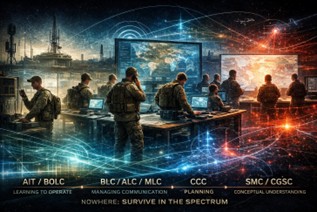
From Advanced Individual Training (AIT) & Basic Officer Leader Course (BOLC) through Basic Leaders Course (BLC), Advanced Leader Course (ALC), Master Leader Course (MLC), the Captains Career Course, and CGSC (Command and General Staff College), the electromagnetic spectrum is present, but it is not integrated.
At AIT and BOLC, Soldiers and Lieutenants learn how to operate radios. They learn frequencies, call signs, and reporting procedures. They become technically proficient operators. What they are not taught is that every transmission is a decision with consequences, that emitting creates a signature that can be detected, classified, and targeted.
At BLC, ALC, MLC, and CCC, NCOs and officers begin to plan and synchronize communications. They build PACE (Primary, Alternate, Contingency, Emergency) plans, allocate systems, and manage information flow across formations. But emissions are still treated as an enabler to be layered onto the plan after it is built, rather than a constraint that shapes how the plan must be designed from the start.
At CGSC field grade officers discuss the spectrum in terms of capabilities, protection, and effects. It is incorporated into operational frameworks and briefed during planning. But even here, it often remains conceptual rather than something that fundamentally drives how formations are organized, dispersed, and employed.
Across every level, the pattern is the same: we treat the electromagnetic spectrum as an input to the plan, not a condition that defines it.
I see this every day in my own formation. Soldiers know how to use their equipment. NCOs know how to manage it. Officers know how to plan with it. But very few are trained to think about what their emissions are doing to them in the fight.
We are teaching a model of warfare that assumes communication is free.
Stop Adding Electronic Warfare (EW) Classes, Start Changing Behavior
The solution is not more instruction. It is better integration.
You do not need a new block on the electromagnetic spectrum. You need to change how every existing block is taught. At the most basic level, this means introducing constraints that force students to confront the cost of emitting.
At AIT and BOLC, the focus should be behavioral.
Every transmission in training should be evaluated not just for accuracy, but for duration and necessity. Cadre should enforce strict limits: short transmissions, enforced brevity, and consequences for excessive time on air. If a student talks too long, they should be “detected.” If they repeat transmissions unnecessarily, they should be “targeted.” The lesson is simple: say less, say it clearly, and then stop transmitting.
At BLC, ALC, and MLC, that behavior must become discipline.
NCOs should be required to train their formations to operate under constraint. This means rehearsing under jamming, enforcing emission control (EMCON), and building training plans where communication is degraded or denied. The standard is no longer just communication, it is disciplined communication under pressure.
At the Captains Career Course, integration should become procedural.
During planning, electromagnetic exposure must be treated like any other constraint. When developing courses of action, students should have to answer questions like: How long can this unit transmit before it must displace? What is the emission control posture during each phase of the operation? Where are the points of highest signature risk?
If those questions are not addressed, the plan is incomplete.
At CGSC the focus should be conceptual and operational.
Field grade officers should be forced to design operations that assume the network is contested, degraded, or actively working against them. This means shorter command post dwell times, greater dispersion, and a reliance on mission command rather than continuous oversight.
It also means accepting that more communication is not always better communication.
Train the Consequences
If you want this to matter, you have to make it real. The only way to do that is to enforce consequences in training.
This starts with how units conduct digital sustainment and command post operations. Set hard limits on transmission time. After a certain threshold, simulate detection. After repeated emissions, simulate geolocation. If a section or platoon continues to transmit, treat it as targeted and remove it from the fight.
Command posts should not be allowed to sit static and transmit indefinitely. Once a signature threshold is reached, they displace. If they don’t, they are destroyed. No warnings, no resets.
Introduce friction deliberately. Degrade communications. Disrupt networks. Force leaders to operate with incomplete information. Then require them to continue the mission.
This is not something you brief. It is something you enforce. Soldiers and leaders will not change how they operate because they were told the spectrum matters. They will change when they see what happens when they ignore it.
The Future SITREP
All of this converges on a simple but profound shift: communication must become faster, shorter, and more precise.
The future battlefield will reward leaders who can compress information without losing meaning.
A good SITREP will not be the one that includes everything. It will be the one that communicates intent in seconds and then goes silent.
This requires discipline. This requires training. It requires shared understanding. And it requires trust.
Leaders who demand constant updates are increasing their unit’s exposure. Leaders who empower subordinates with intent and accept less frequent, more concise communication are increasing survivability.
A Command Philosophy Problem
This is not just about the electromagnetic spectrum. It is about how we think about command. For decades, technology has pushed us toward greater connectivity. More data. More visibility. More control.
But in a contested electromagnetic environment, those advantages can become liabilities. If your formation requires continuous communication to function, it is fragile.
If your formation can operate with minimal communication because intent is clear, roles are understood, and subordinates are trusted it is resilient. Mission command is not just a leadership philosophy in this environment. It is a survivability requirement.
Key Takeaways for Leaders
The spectrum is terrain. Every emission is a position report to the enemy. Plan and fight accordingly.
Duration drives detection. A longer transmission is not more thorough; it is more targetable. Train your formations to transmit briefly, then go silent.
Encryption is not concealment. An adversary does not need to read your transmissions to geolocate your headquarters. The signal itself reveals your position.
Mission command is a survivability tool. Formations that require continuous communication to function are fragile. Clear intent, trusted subordinates, and disciplined silence are force multipliers in a contested electromagnetic environment.
The standard must change in training. We cannot grade on content and ignore duration. Enforce emission limits now, in every exercise, at every level; or accept the consequences in combat.
If You Transmit, You Are Targetable
The electromagnetic spectrum is not an abstract domain. It is a battlefield where every emission has consequences. Right now, we are training leaders to operate as if those consequences are minimal.
Until we integrate the spectrum into how we teach, plan, and execute, until it is considered at the same time as maneuver, not after; we will continue to produce formations that are tactically sound but electromagnetically exposed.
Because if you transmit, you are targetable.
And if you are targetable, you are killable.