
Depth Theory
Depth Theory
The art of war is simple enough.
Find out where your enemy is.
Get at him as soon as you can.
Strike him as hard as you can, and keep moving on …
-Ulysses S. Grant
I. Introduction.
Among the four tenets of operations outlined in US Army doctrine – agility, convergence, endurance, and depth – it is depth that most directly governs the translation of tactical success into lasting operational outcomes. Field Manual (FM) 3-0, Operations, defines depth as “the extension of operations in time, space, or purpose to achieve definitive results.” This definition is elegant in its simplicity, yet its practical application is profoundly complex.
The contemporary operational environment, saturated with sensors and networked fires, has led many to view depth through the narrow lens of physical space, equating it merely with long-range precision fires or deep maneuver. This perspective is dangerously incomplete. It mistakes a single concept for the entirety of Operational Art (OpArt) and neglects the temporal and cognitive perspectives that give depth its decisive power.
This article seeks to address this by framing depth as a comprehensive theory. Therefore, Depth Theory suggests that the primary function of depth is to orchestrate the disintegration of the enemy’s entire operational system by forcing it to culminate before it can achieve its objectives. It is fundamentally a theory of anti-culmination, designed to defeat an adversary throughout the operational framework, not just at the forward line of troops.
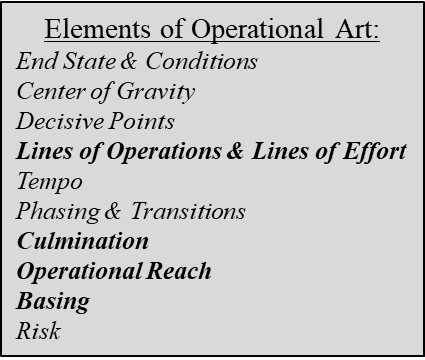
To build this theory, we must analyze depth through the lens of OpArt, as depicted in Army Doctrine Publication (ADP) 3-0, Operations. While all elements of OpArt are inter-related, Depth Theory is principally animated by four: Lines of Operations and Lines of Effort, Operational Reach, Basing, and Culmination.
By synthesizing these doctrinal concepts, we can move beyond a one-dimensional view of depth as mere distance and embrace it as the art of arranging tactical actions in purpose, time, and space to achieve definitive strategic results.
II. The Triad of Depth: Re-examining the Doctrinal Definition.
The power of the doctrinal definition lies in its three components: space, time, and purpose. These are not a menu of options from which to choose, but an indivisible triad. An operation that has spatial depth but lacks purpose is merely a raid; one that has purpose but lacks temporal depth risks winning a battle but losing the campaign.
Therefore, Depth in Purpose is the cognitive dimension and the most crucial. It provides the unifying logic – the “why” – that connects every action across space and time. Every patrol, every artillery strike, and every cyber operation must be tied to a clear purpose that contributes to the operational end state. To be clear – without purpose, depth is simply unfocused violence. As Section II of FM 3-0 makes clear, the generation and application of combat power is the central task in operations. Depth in purpose ensures that this combat power is applied efficiently and effectively, preventing the wasteful expenditure of resources on actions that do not contribute to the commander's intent and higher goals.
Next, Depth in Time, is the temporal dimension. It is the art of sequencing and synchronizing actions to shape future conditions. Commanders achieve temporal depth by understanding that the operational environment is not static. An action taken now – such as destroying an enemy C2 node – will produce cascading effects hours or days later. Temporal depth allows a commander to control the tempo of a campaign, not just a single battle. It involves looking beyond the current fight to set the conditions for the next one, ensuring that the enemy is always reacting to a previous friendly action while friendly forces are already initiating the next.
Lastly, Depth in Space is the physical dimension. It involves arranging operations across the length, width, and height of the operational environment. It is about affecting the enemy not just at the point of contact but simultaneously throughout their system – from their forward security elements to their theater-level sustainment nodes. This requires a commander to layer and integrate effects from all domains – land, air, maritime, space, and cyberspace. The spatial dimension is what allows a commander to create multiple physical dilemmas. By threatening the enemy in their deep and rear areas, the commander forces the enemy to divert combat power away from the main effort, dissipate their reserves, and defend a wider area than they can effectively control.
III. The Architecture of Depth: The Role of Operational Art.
The triad of purpose, time, and space tells us what depth is. The elements of OpArt, however, provide the architectural framework for how depth is achieved and, more importantly, how it is constrained. The effective employment of depth is not a matter of will, but a cold calculation based on the interplay of four key elements of OpArt.
Lines of Operations and Lines of Effort. These elements are the intellectual guideposts for applying depth. A Line of Operation (LOO) is a physical path that connects a force to its objective. It is the manifestation of spatial depth, organizing the fight geographically. In contrast, a Line of Effort (LOE) links tasks by their common purpose, not their location. An LOE to “Degrade Enemy C2” might involve simultaneous cyber, space, and fires effects across the entire operational area. LOEs are the practical tool for executing depth in purpose. A successful operational design nests LOOs within LOEs, ensuring that every physical action is tied to a cognitive objective.
The Decisive Nexus: Operational Reach, Basing, and Culmination. These three elements form an iron triangle that dictates the absolute physical and temporal limits of depth.
-
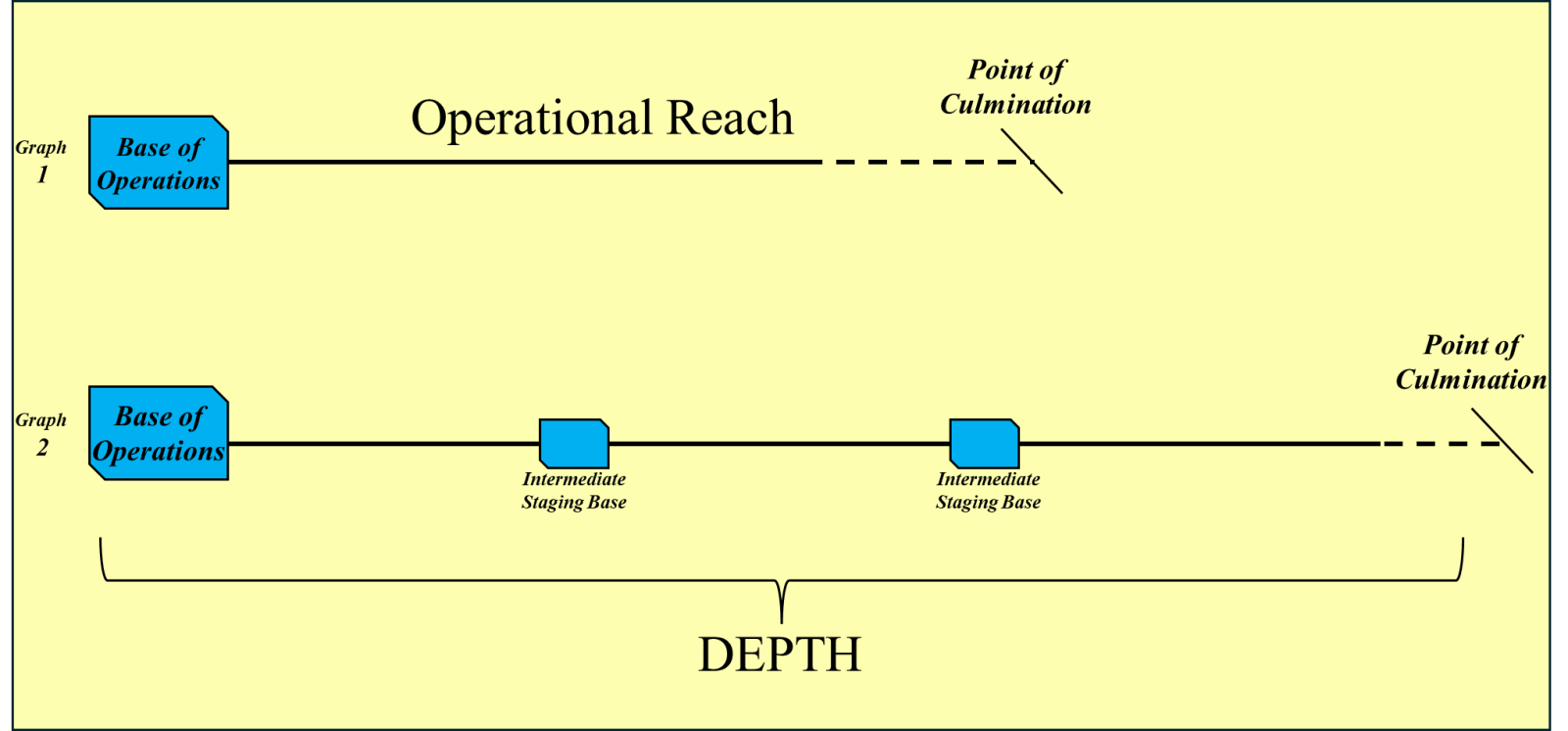
Operational Reach is the logistical and command-and-control tether that connects a maneuvering force to its sustaining base. It is the maximum distance and duration a force can operate before its combat power begins to wane.
-
Basing is the foundational anchor for force projection. The number, resilience, and positioning of bases – whether from continental U.S. ports, intermediate staging bases, or forward tactical assembly areas – directly determine a commander’s ability to generate and sustain combat power.
-
Culmination is the point at which that tether snaps. It is the moment in time and space where the force can no longer sustain itself and must transition to the defense or risk destruction.
As illustrated in Figure 1 below, these elements exist in a state of constant tension. To extend depth (i.e., operate farther from a base), a commander inherently strains their operational reach, which in turn accelerates culmination. A commander cannot wish this reality away. The only way to extend operational depth is to consciously extend operational reach, either by increasing the efficiency and capacity of sustainment or by displacing the base of operations forward. Therefore, a commander's operational depth is ultimately limited not by the speed of their tanks, but by the foresight, and whole-of-staff integration, of their logisticians.
IV. Depth theory in Application: A Framework for Anti-Culmination.
Incorporating these concepts, Depth Theory can be articulated as: the purposeful arrangement of simultaneous and sequential actions in space and time to disintegrate the components of an enemy’s operational system, thereby forcing the enemy to culminate before the friendly force does. It is not about defeating the enemy in a single blow, but about orchestrating their systemic collapse throughout a campaign.
The practical application of this theory is rooted in the concepts of generating and applying combat power described in Section II of FM 3-0, which details how the warfighting functions (C2, intelligence, fires, movement and maneuver, protection, and sustainment) are the tools commanders use to create effects. Depth Theory may guide the commander to apply these warfighting functions not just against the enemy’s forward-most forces, but against the critical nodes of the enemy’s own warfighting functions throughout their entire system.
This framework can be visualized as a sequenced application of effects designed to attack the enemy’s operational architecture.
-
Phase I (Shaping): At the greatest distance and earliest time, friendly operations focus on the enemy’s intelligence and C2 systems. Using joint capabilities in space and cyberspace, complemented by all-weather ground sensors, Army SOF, and long-range fires, the goal is to blind the enemy. We degrade their ability to see their own forces and the friendly advance, creating uncertainty and paralysis at the highest echelons.
-
Phase II (Enabling): As friendly maneuver begins, the focus shifts to the enemy’s sustainment and fires systems. Joint air interdiction and Army attack aviation & fires targeting of enemy logistics nodes, ammunition supply points, Air Defense Artillery, Counterbattery Radars, and Long-Range Artillery. The purpose is to sever the connection between the enemy’s forward combat forces and their means of support, inducing logistical culmination.
-
Phase III (Decisive Action): With the enemy blinded, their C2 disrupted, and their forward echelons logistically starved, friendly maneuver forces can now engage in the close fight with a marked advantage. The enemy’s protection and maneuver warfighting functions are now isolated and vulnerable, having been systematically dismantled by the preceding phased application of friendly combat power in depth.
This methodical disintegration ensures that by the time the decisive tactical engagement occurs, the enemy is already operationally defeated. Their will to fight is eroded, not by the shock of a single battle, but by the relentless pressure of a campaign over time that has left them isolated, unsupported, and fighting in the dark.
V. Conclusion.
Depth, as a tenet of operations, is the master key that unlocks strategic success from tactical action. To treat it as merely a spatial challenge is to ignore its true potential. It is a comprehensive framework for thinking about the operational environment in space, time, and, most importantly, purpose. By grounding our understanding of depth in the practical realities of operational art—recognizing that it is enabled by elements of OpArt such as Lines of Operations and Lines Effort and ultimately constrained by the iron triangle of Basing, Operational Reach, and Culmination – we can design and execute campaigns with a higher probability of success.
Ultimately, Depth Theory provides a cognitive model for this application. It reframes the goal from simply "striking deep" to a more sophisticated objective: orchestrating the enemy's systemic collapse. It is a guide for applying the warfighting functions described in FM 3-0 to systematically dismantle the enemy’s ability to generate their own combat power in space and over time. It is also the notion that drives a friendly commander’s decisions on sustaining the force over time, purposefully regenerating combat power, as well as adapting to the enemy reactions to our own actions throughout the entirety of the battle space. In the end, Depth forces commanders to ask not "How far can we strike?" but "What effect, at what time and place, will most effectively hasten the enemy's culmination?" By answering that question, commanders can leverage the tenet of depth to achieve definitive, lasting victory.
References:
ADP 3-0, Operations, 21 March 2025
FM 3-0, Operations, 21 March 2025
Authors’ Information:
Lieutenant Colonel Brandt Murphy serves as the G33, Chief of Current Operations, for the 1st Infantry Division on Fort Riley, KS. He is a graduate of the Advanced Military Studies Program (AMSP/SAMS) and is currently pursuing a Ph.D. in Leadership Studies from Gonzaga University.
Colonel Jabari Miller serves as the Deputy Commanding Officer for Maneuver for the 1st Infantry Division on Fort Riley, KS. He is a graduate of the National War College with a Master of Arts in National Security and Strategic Studies.